I don’t know whether you have ever paid three hundred dollars a month for silence and been handed, instead, a man with a snorkel. If you have, we need not go on; you may pour yourself something and sit quietly with me. If you have not, allow me to describe the transaction, because I feel the public ought to know.
The theory was sound. The theory was, if I may say so, rather elegant. One selects the expensive establishment — not for the towels, which are merely towels with ambitions, nor for the apparatus, a barbell being a barbell in Vienna as in Van Nuys — but on the reasoning that a sufficiently unpleasant monthly figure will function as a moat. Three hundred dollars a month, I reasoned, is a sum that repels a certain kind of person. Not the poor man; the poor man is frequently charming. I mean the man who leaves the bench glistening. I mean the man who films himself. I was purchasing, at considerable expense, the absence of such persons.
In the country where I was raised one did not have to buy this. It arrived bundled, as it were, with the plumbing. Nobody instructed you not to shout in a swimming bath; the notion of shouting in a swimming bath simply did not occur to you, in the way it does not occur to you to eat a sofa. Here one must pay for it, and — this is the discovery I bring you today, at some personal cost — one pays and does not receive it.
Let us discuss the pool, and let us begin with its constitution, because the constitution matters.
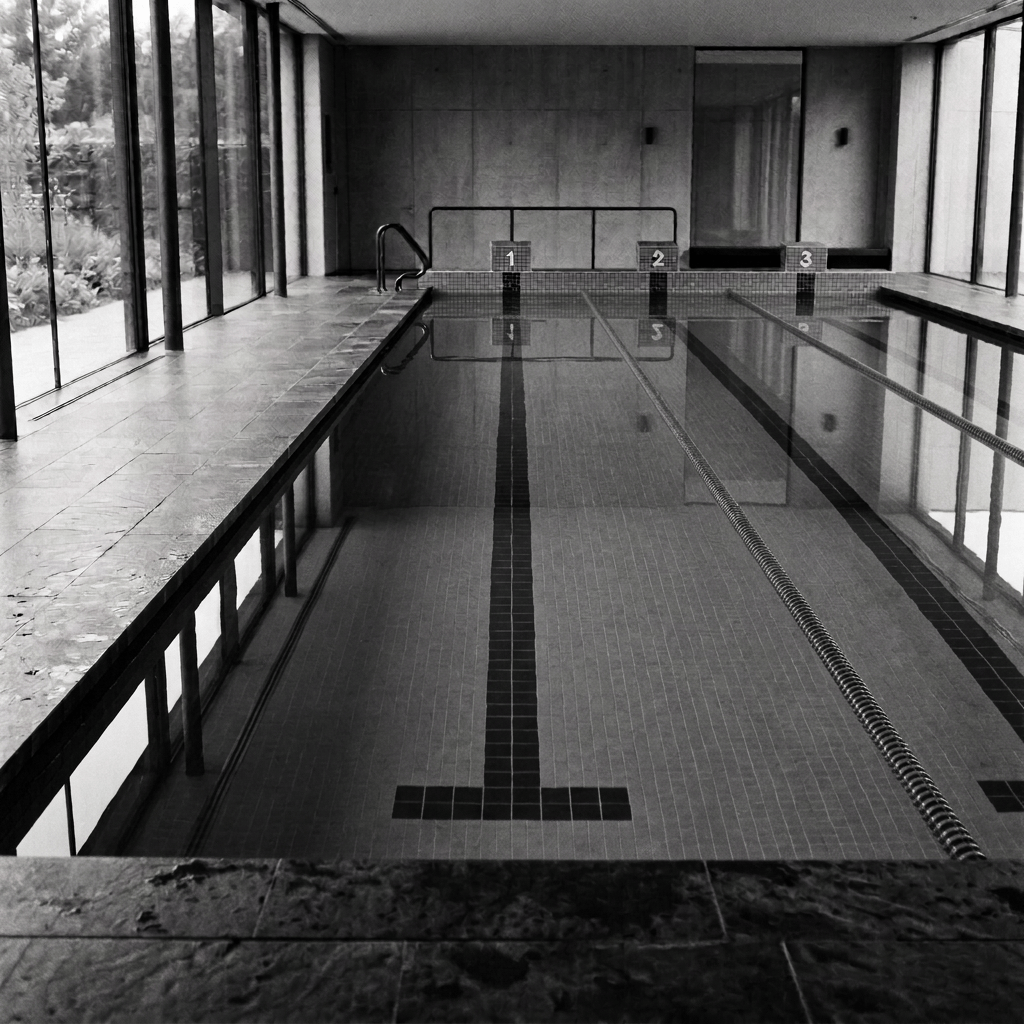
There are three lanes. The far left and the far right may be reserved in advance by those who plan their mornings, i.e. by adults. The middle lane is unreserved — open to all comers, first arrival, no ceremony — a slender channel of pure democracy running down the centre of an otherwise well-ordered body of water. I have never objected to its existence. Every society needs somewhere to keep the mob.
Saturday. The hour so early that it exists for no reason except the avoidance of one’s fellow man. I am in the far right lane, which I have reserved, as I say, being an adult. The middle lane: empty. The far left lane: empty. The water lies flat as a sheet of glass, the light coming through it in that particular way, and for approximately nine minutes I am the happiest man in the county.
Then the doors open, and he comes.
He does not carry his equipment. He deploys it. Fins, and not small ones — fins in the manner of a creature that has taken a wrong turn in the evolutionary record. Hand paddles, being flat plastic shovels strapped to the palms of a man who has evidently concluded that the trouble with his stroke was insufficient surface area. A snorkel. A kickboard. A pull buoy. Two further items which I have never identified and now decline to. He lays this ordnance upon the tiles like Napoleon laying out the Grande Armée, and he surveys the three lanes.
Two of them empty. One containing a human being.
Reader: he chose the middle.
I want you to sit with the geometry, because the geometry is the crime. He might have gone to the far left, where no living soul would have known he was there, where he could have thrashed in blessed anonymity until the chlorine gave out. He instead crossed the deck, past that vacancy, past the invitation of it, and installed himself in the one lane on God’s earth that shares a rope with me. Given the whole Atlantic he would have found the one raft and asked to sit on the edge of it.
And then he began to swim, and I understood that the equipment had never been about speed. It had been about volume.
There are men who place a hand into water. A knife into a drawer; a letter into a slot; a bishop into a chair. This is not such a man. What occurs is that the arm ascends — ascends to an altitude at which it is fair to describe it as weather — hangs there a moment in the manner of the sword of Damocles, and then descends upon the surface of the pool like the blade of a guillotine with strong opinions about the aristocracy. It does not enter the water. It arrives at the water. It arrives the way a grand piano arrives at a pavement from the fourth floor, and the water, being water, responds as water does, which is to say upward, and in my direction.
Vesuvius, one recalls, gave the residents of Pompeii several days of clear warning. The Admiral gives none, and issues every 1.4 seconds, for forty-five minutes, with the terrible metronomic devotion of a man who is genuinely giving it his all.
Now here is the part that curdles the blood, and I ask you to attend closely, because it is the thesis of this entire enterprise.
He broke no rule.
The middle lane is open to all. He is all. He paid his three hundred dollars precisely as I paid mine, and he is entitled to stand in that water and beat it about the head and shoulders until it confesses. There is no sign he defied. There is no official I might summon. Were I to complain, I should instantly become the villain of the story — the Continental snob at the expensive gymnasium demanding the public be cleared from the public lane so that he might enjoy his private sea. And he would be right. That is the maddening part. He would be right.
Because rules tell a man what he may do, and manners told him what he may not, and only one of these two documents has survived the crossing. The gap between them — the whole vast, breezy acreage between permitted and decent — is where I now spend the greater part of my waking life, waist-deep, being splashed.
He had read the constitution. Nobody had given him the other thing.
I did, of course, give him the Look.
I should like to be understood on the calibre of the Look. It is a Look with a pedigree. It has silenced a sommelier. It has ended a dinner party in three languages and been discussed afterwards in a fourth. Deployed at six inches through a pane of chlorinated water at a man whose head is submerged, whose ears are full, and who is at that moment having the single finest morning of his life, it achieved — I have checked the figures — nothing whatsoever. It struck the surface, went in, and was not seen again. No dirty look in the recorded history of swimming has ever once arrived at its destination. We go on sending them, like the Portuguese sending ships west.
I completed my set. I went home. I spent the better part of a Saturday assembling, polishing and delivering to an empty room a devastating address to a man who does not know that I exist.
The moat, I have concluded, was always ornamental. Dig it as deep as you like. Fill it with three hundred dollars a month, fill it with eucalyptus and frosted glass and eleven minutes of steam. It will not keep out a man who has woken up and decided that today, by heaven, he will swim.
I should like a refund on the difference.
 Dear Other People...
Leave a comment