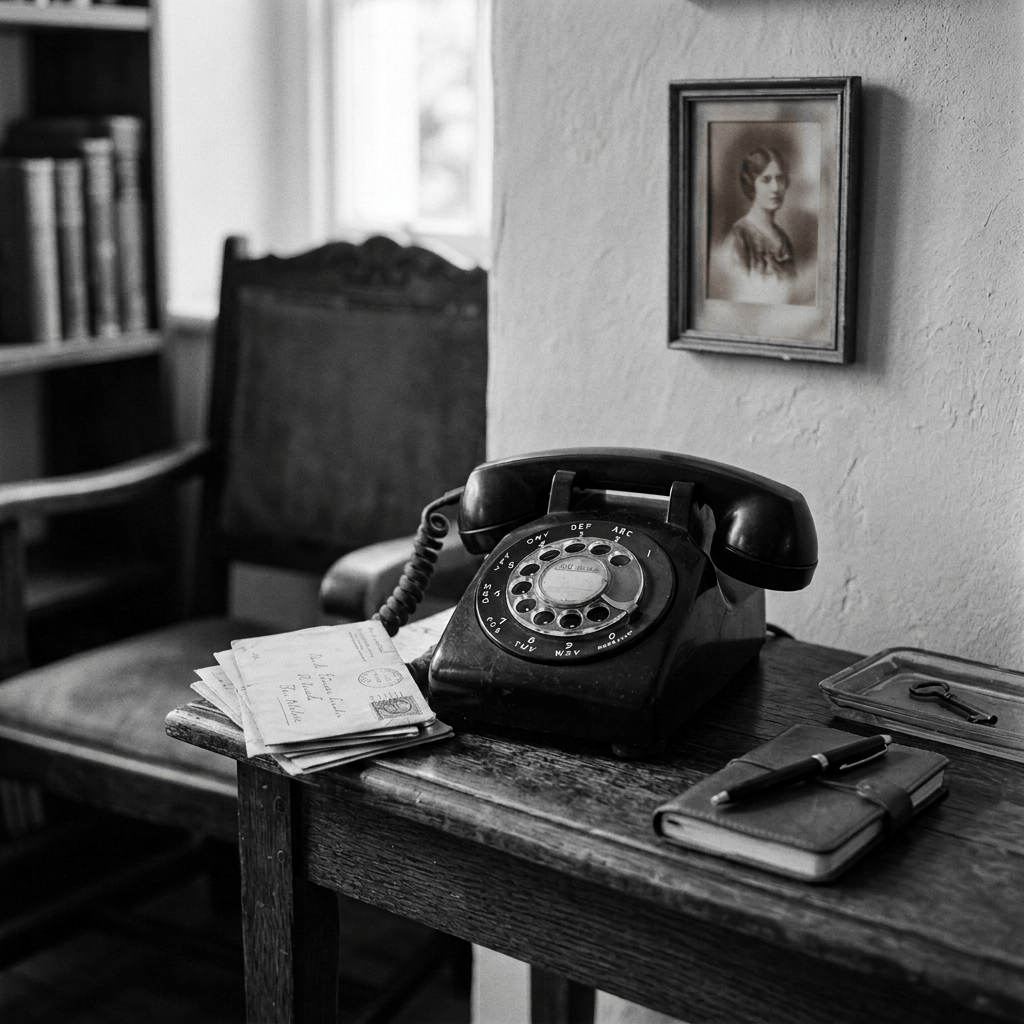
I don’t know whether you have ever been telephoned while on the lavatory by someone who wanted nothing. If you have, come and sit by me; we shall say nothing — indeed, saying nothing is rather the theme of today’s sermon. If you have not, then you are either a hermit or a liar, and in both cases I envy you, and I must ask you to attend anyway, because I intend this morning to deliver a eulogy. The deceased: a civil right so thoroughly extinct that most people no longer believe it existed. I refer to the right to be unreachable.
I was there. I remember it. Let me tell you how we lived.
When I was a boy, the telephone was a magical box, and its ring was Christmas morning and one’s birthday rolled into a single electric event. You did not know who was calling. Consider the sheer romance of that. It might be anyone. It was never, I can report with the confidence of an eyewitness, a gentleman in a distant call centre impersonating the Microsoft Corporation and proposing to repair my computer in exchange for five thousand dollars in gift cards. The ring was pure possibility, and the whole household oriented toward it like plants toward a window.
And the instrument itself was, like the cat, attached to the house. It lived there. It had a place, and it knew its place. One answered it with ceremony — “the Smith residence” — and the party at the other end promptly identified themselves, stated their business, and proceeded to a swift and orderly transaction, because time on the telephone was money, and not figurative money. Every minute was billed. Long distance required engaging a separate long-distance company entirely, at rates comparable to funding a child’s education, and one chose one’s words the way one chooses them in a telegram or a ransom note. International? One did not telephone the old country; one budgeted for it, quarterly. When I first arrived in the New World, a single minute of conversation with the Old ran somewhere between fifty cents and a dollar — call it three dollars in today’s currency — and I promise you that at three dollars a minute, nobody, in the recorded history of telephony, ever called to ask what you were up to.
This economy enforced a decency that no etiquette book has ever matched. Calls had purposes. A relative rang because someone had died, or married, or was about to do one or the other, or to arrange a coffee. Then everyone hung up, with the satisfaction of a transaction well and cheaply concluded.
Mind you, the instrument had its recreations. I do not wish to paint my childhood as a monastery. In an age when the home’s entire entertainment complex consisted of a radio, a cassette deck, and a television with the channel selection of a Soviet newspaper kiosk, a boy of imagination made his own arrangements. One could dial a number and be told, by a woman of magnificent indifference, what the time would be at the tone — a service I consumed the way children now consume video, and which, I note, never once asked me to subscribe. And there was the phone book: a municipal volume weighing a metric tonne, containing the name, address, and number of every household in the city, out of which a young scholar could mine the comedically surnamed and ring them up for purposes of research. I offer no apology. It was a more innocent form of telephone harassment, artisanal and small-batch, conducted by local children rather than international syndicates, and I like to think the victims understood they were participating in something of a civic tradition.
But here is the part I need you to sit with, because it is the load-bearing wall of this entire essay: it was perfectly normal for the telephone to go unanswered. You rang; nobody was home; the matter waited. Nobody spiralled. Nobody assumed you were dead or, worse, avoiding them. The telephone was a door, and a door may go unopened, and civilisation continued.
Then arrived the answering machine, and with it, I would argue, the golden age of the entire technology — the brief, shining moment when the machine worked for us. The answering machine was a butler made of tape. It took the message so that you didn’t have to take the call, and — glorious detail — it let you listen while the message was left, screening your callers from behind the arras like a Renaissance prince. And into the outgoing message went more creativity than currently goes into most streaming platforms. “Leave your message after the beep” was merely the standard edition. There were artisans among us. “If you want to hear ‘no’ in German, press 9.” The false start — “Hello? … Hello? … I can’t hear you!” — followed by the beep and the caller’s soul briefly leaving their body. The corporate parody “Your call is important to us, please stay on the line…”, complete with thirty seconds of hold music before the tone. And the minimalists, whom I admired most: “I’m out. If I’m in, I’m ignoring you.” Or simply — “Speak.” [Beep.] A one-word constitution. An entire philosophy of communication in seven letters, and every syllable of it correct.
Then came the pager, and I will defend the pager, with conditions. It was a boxy little thing worn on the belt with the pride of a sidearm, a genuine status symbol, and it introduced — let the record show — the first crack in the wall: it was the first device that followed you out of the house and requested a reaction. But note the manners of it. The pager was one-way. It did not ring; it beeped, once, and presented you with a number, and sometimes — if you moved in cultivated circles — a message in the numeric cipher of the age. 07734, which upside down spells a greeting. 143, which counts out “I love you” letter by letter, and remains the most romantic thing anyone has ever done with arithmetic. 411 for “I have a question”; 911 for “call me this instant”; 187 for “you are in trouble of the terminal variety”; and one eight-digit number, popular among schoolchildren of the calculator era, which when inverted produced a word I decline to reproduce in a respectable publication.
And having been paged, what happened? You decided. You excavated the glove compartment for quarters, located a payphone that was not an active biohazard, and called back — or you did not, and there existed for this a beautiful, load-bearing institution called the plausible excuse. Couldn’t find a phone. Didn’t get the page. Battery. The pager requested; it did not command. It was the last device in history to address me as “sir.”
Then came the cellphone for the masses, and the fall of man.
It arrived humbly enough — expensive, pay-per-minute, still governed by the old economics of scarcity. But the technology caught up, and the companies began their arms race: more minutes, then unlimited nights and weekends, then unlimited long distance, then unlimited everything, until we arrived at the present arrangement, in which every call and every text is free, and FaceTime, WhatsApp, Messenger and the rest of the weapons of mass distraction have between them abolished the last sacred square foot on the surface of the earth. There is no place and no moment that is yours. You may be at your morning devotions on the porcelain throne; you may be operating heavy machinery; you may be engaged in one of the various pleasures; you may be napping, or simply exercising the ancient human right to be antisocial in a corner — no matter. You are expected to carry the doom machine on your person at all hours, and you are expected to be available, and the word “available” has quietly changed its meaning from “willing” to “obligated.”
And I ask, first and foremost: why must everyone talk? We possess technologies exquisitely suited to conveying a message in a short text, or indeed a single emoji — an entire hieroglyphic system, refined over a decade, capable of expressing anything from condolence to lunch. And what has the age done with this gift? It has invented the voice text — the recorded voice message inside the texting apparatus — an oxymoron to file alongside “advanced basic” and the express service of the postal system: the one invention that combines the intrusiveness of a call with the inconvenience of a message, so that the recipient may enjoy the worst properties of both.
And things descend from the merely horrible to the frankly demonic on a schedule: every election season, every campaign, every stretch where one has neglected to change one’s number, the device goes off the hook — a phrase, I realise, that no longer means anything, there being no hook — and sets about excavating a hole in one’s back pocket, vibrating with urgent communiqués from politicians, scammers, and telemarketers, three professions that have converged so completely in method that I can no longer reliably tell them apart, and I am not sure they can either.
But I have saved a special chamber of this inferno for a particular offender, and I must ask you to descend into it with me, because you have met them. Everyone has met them. They are at the gymnasium. They are in the queue at the Costco, becalmed between the pallet of rotisserie chickens and the drum of mayonnaise. They are anywhere, in short, where the human condition obliges us to share a cubic yard of air with strangers — and they are on a call, and they have decided, with the serene entitlement of someone who believes the First Amendment was drafted, debated, and ratified specifically to protect their dinner plans, “Freedom of Speech” meaning that the call shall be conducted in public session.
Observe the posture, because the posture tells you everything. They do not hold the device to their ear, in the ancient and decent manner, whereby at least one half of the proceedings remained confidential. No — they hold it flat, horizontally, some inches before their lips, the way one carries a freshly buttered piece of crisp toast that one is about to bite, and they address it, at parade volume, while the counterparty is broadcast on the speaker for the enrichment of the assembled public. And so an entire aisle of strangers — captive, unconsulted, unpaid — is press-ganged into the proceedings and learns, whether it wished to or not, what little precious had for breakfast, and that we mustn’t forget the cereal, and the milk, the low-fat, mind, and how the weekend went, which was fine, which was always going to be fine, which could have been established in a four-word text or, at the outer limit of the technology, a single thumbs-up.
I have given this behaviour a good deal of thought, generally while trapped behind it, and I have concluded that it is not even communication. Communication does not require an audience of conscripts. It is performance — the broadcasting of one’s connectedness to a hall that never bought tickets — and the speakerphone is its megaphone, and the queue is its theatre, and I am, week after week, its critic, filing reviews that no one will ever read.
And you will notice, I hope, that these are not two complaints but one. The person who rings me in my bath and the one who broadcasts their breakfast negotiations across the Costco are committing the identical offence from opposite ends of the wire: each has decided that the space between their mouth and my ear is theirs — mine to furnish, theirs to fill.
Now, I want to be fair, because I am famously fair. It is not the technology that is to blame. As the rifle lobby is fond of saying, it is not the gun that kills people; and likewise it is not the phone that ruins your Sunday. People do. The phone is merely the delivery system. The industry has even furnished remedies — the Do Not Disturb mode, which I confess has personally stood between me and professional help, and on at least two occasions between the twelve-hundred-dollar masterpiece of engineering and the toilet, and on one further occasion between it and a splitting maul. But Do Not Disturb treats the symptom. The disease is the expectation — the serene, universal, unexamined assumption of other people that you will drop whatever you are doing, whoever you are doing it with, and attend to their urgent need to communicate. And should you decline — should you let it ring, as every household in the civilised world once did without a second thought — you are the one who is antisocial. You are rude. No, madam. No, sir. I must insist on the correction: invading a person’s pocket, their desk, their dinner, their bath, and their bed, twenty-four hours a day, on the assumption that they are a public utility — that is antisocial. That is rude. I have merely declined to answer a door. You have moved into the doorway.
There used to be a protocol for all of this, and I commend it to the age. Do you know the original purpose of the business card? It was not for networking. It was left with the butler — the calling card, announced upstairs on a small silver tray — and the household then consulted its diary, and a time was proposed, and at the mutual convenience of both parties, the communication took place. The entire apparatus existed to protect a single principle: that access to a person is granted, not seized. Today the whole ceremony has been compressed into “hey Siri, call John,” and poor John — on the jon, as likely as not, this being statistically the one appointment everyone keeps — must now rise and attend to the urgent matter of “just wanted to see how you’re doing,” a phrase which thirty years of field research allows me to translate precisely: I am bored, and your discomfort amuses me, or alternatively, I need something. For I have kept careful records, and in the entire history of my telephone being answered, not one incoming call has ever realistically offered me a large sum of money or proposed to wash my car.
So here is the thesis, since I owe you one, and this one I have been paying into my whole life. The greatest luxury in existence is not the mattress, nor the espresso, nor the gymnasium with the ambitious towels. The greatest luxury is to be the master of your own time and your own head — to decide, hour by hour, who may enter and who shall wait — and it is the only luxury that other people can steal from you at no cost to themselves, one ring at a time. The old world understood this and built butlers, calling cards, answering machines and long-distance rates to defend it. The new world has decided it is a form of rudeness.
I am at home. The device is on silent, face down, in another room, thinking about what it has done. If you wish to reach me, leave your card with the butler. I haven’t got a butler, but then, with any luck, you haven’t got my number.
And if you must call — don’t.
 Dear Other People...
Leave a comment