On the invisible architecture of an empty beach
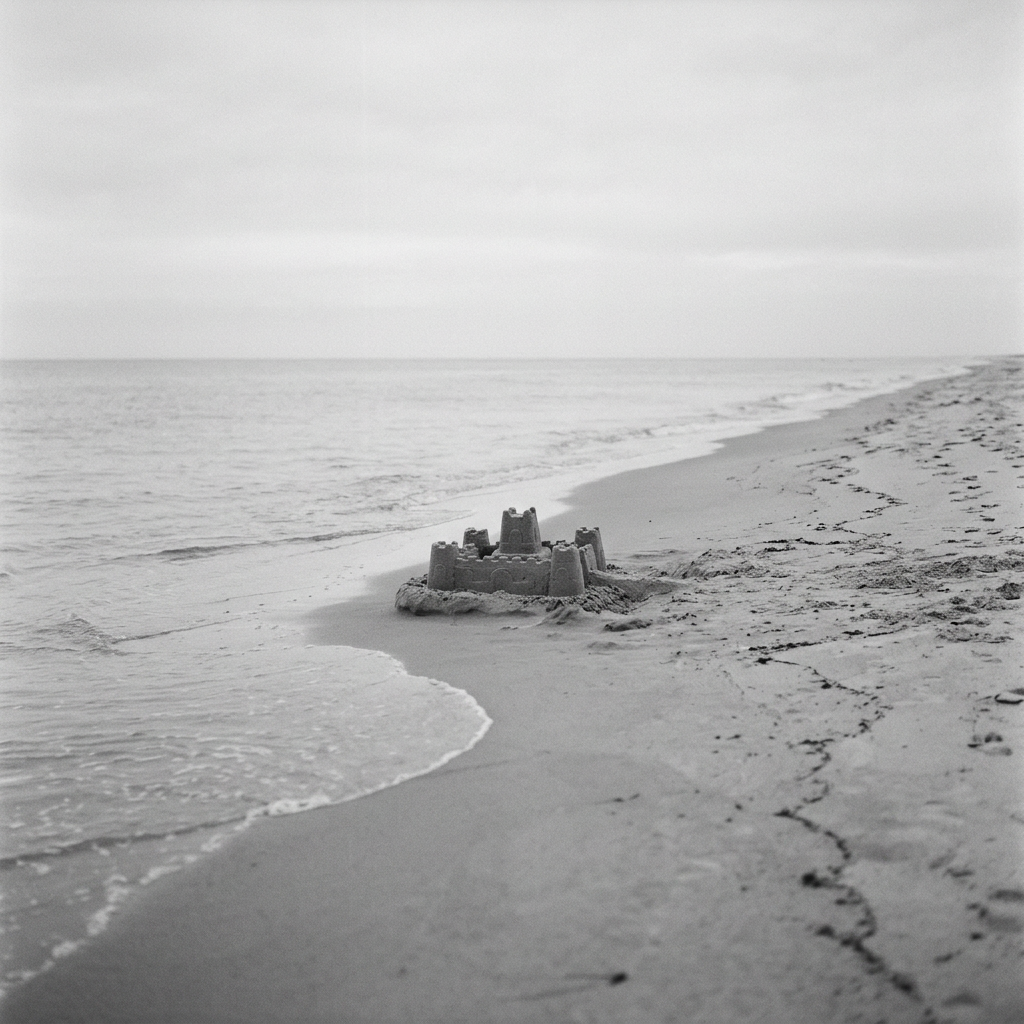
I don’t know whether you have ever fled your own home and been pursued to the edge of the continent. If you have, come and sit by me — though not too close; that, as you will see, is rather the point. If you have not, let me describe the flight, and the pursuit, and the ten feet of sand where the whole philosophy of civilisation finally ran out.
The day began badly, which I mention only because it explains the desperation of what followed. The weather has been hot, which is seasonal, and humid, which is not — the air has taken on the texture of soup, and not a good soup. Into this soup I had, some weeks ago, in a moment of madness I am still investigating, introduced a remodelling project, which is to say I had invited men with drills into my house and agreed to pay them for the privilege. And so last Friday found me attempting to conduct my morning calls with Europe while the following orchestra performed around me: the drill, in its upper registers; a mosquito, which had breached the perimeter and was making unhurried arrangements to dine on me; the great financial debate of our age, namely whether to run the air conditioner or to eat next week, both being no longer fiscally possible; and, floating above it all from the portable speaker that the construction trade now carries the way earlier generations carried a lunch pail, a Mexican minnesinger lamenting a lost love with a commitment I could only envy — a man who had clearly lost everything and yet, unlike me, had found a label willing to record it.
The cat, meanwhile, had reviewed the available seating in the house and concluded, as he always concludes, that the premium accommodation was my keyboard. My open document began to populate itself with his correspondence — fgfggfgggggggggggggggg, followed by a long meditation in forward slashes, followed by a string of rapid beeps from the machine itself, which I chose to interpret as the laptop echoing my own heart rate. I sat there, in the soup, in the noise, reading the cat’s memoirs as they were composed live upon my quarterly projections, and somewhere between the slashes it dawned on me — the way dawn comes to a prisoner — that I could simply leave.
Options were considered. The mall: air-conditioned, yes, and one may observe the consumer in his natural habitat, but one goes to the mall to study civilisation, not to recover from it. A hike: the world from above has its appeal, but the world from above in soup-grade humidity is merely the soup with a view. And then — the beach. The beach! I live, I am almost embarrassed to report, nine miles from one of the most famous beaches on the face of the earth. The Beach Boys wrote it songs. Television has invested millions of dollars of silicone in its legend. And I was sitting in a construction site reading a cat’s diary, contemplating. There are moments when a man hears his own life from the outside, and this was one. We are going, I announced to no one, to the beach.
Twenty minutes through one of the most picturesque canyons in the state — the kind of drive that films use to convince you the character’s life is going well — and I arrived. And, reader, it was heaven. Sun. A light breeze. Parking, effortless, which alone should have warned me that I had left the known universe. Miles — I want this on the record — miles of fine white sand, and scarcely a soul upon them. I stood there and the entire astronomical cost of living in this place suddenly balanced its own books. The hustle, the calls at dawn, the corporate indignities, the drill, the minnesinger — all of it, in a single stroke, worth it, for this patch of heaven twenty minutes from my door.
I raised my modest shade. I laid myself down. The surf did the thing that surf does, which no speaker in any tax bracket has ever reproduced. There were dolphins — actual dolphins — conducting their business in the water before me, unpaid, uninstructed, perfect. I closed my eyes and began the slow descent into the first true peace of the fiscal quarter.
And then the ground moved.
Slightly. A few grains of sand relocated. An earthquake, I assumed — we get them here the way other places get drizzle, and local doctrine says that below magnitude five one does not even open an eye. I descended another fathom into the meditation. Then the ground moved again, rhythmically this time, and I must reach for the cinema to explain what happened next, because you have seen this scene. You remember the ice planet — the rebels in their igloo base, and the moment they do not so much hear as feel the Imperial Walkers approaching, the thump, the little crystals shaking loose from the walls, the dawning understanding that something enormous and mechanised and utterly indifferent to them is coming over the horizon. It was exactly that, with two amendments: it was hot, not Hoth, and what trembled loose was sand.
I opened the left eye, adjusted it to the glare, and beheld them.
A family. Four adults, seven children, combined take-off weight in the region of twenty tonnes, advancing up the beach in lockstep with the tread of a column that has been marching since before recorded history and does not intend to stop for it. Each member of the expedition — and I include the children, down to the smallest, who could barely be seen behind his cargo — was laden with bulky, wrapped artefacts, some carried, some dragged behind them in the sand, leaving furrows like the sledges of a pharaoh’s work crew. The children then realised, all at once, where they were, and detonated into running and shrieking, and the parenting detonated immediately after it — high shrieks from the mothers, low rumbles from the fathers, in what my ear identified as Russian bearing a distinct accent of the Caucasus. And I lay there, one eye open, and I prayed. I prayed non-denominationally and at volume, to every god currently taking submissions, that this caravan be granted a sign — a turn to the north, a turn to the south, anything — that would place their encampment as far from my square of heaven as this enormous, empty, miles-long beach so generously allowed.
I must learn to pray better.
The capo di tutti capi of the family — a man built like a load-bearing wall, surveying the shoreline from beneath brows you could shelter under — extended one arm, indicated a patch of sand, and issued a single syllable of command: “TUDA!” — “there,” a word which in that mouth carried the full administrative force of an imperial decree. And tuda, dear reader — of all the tudas available on one of the longest, emptiest, most celebrated beaches in the western world — tuda was ten feet from me. Ten feet. In my direct sightline to the dolphins.
What followed I can only describe with professional respect. The crew did not waste a second. The wrapped artefacts were opened and revealed themselves to be an elaborate system of metal tubes, ropes and acrylic fabric, and the two men assembled it with the speed and wordless coordination of a surgical team, or a pit crew, or — the comparison that actually came to mind as the structure rose and rose — a military engineering corps throwing a bridge across a river under fire. The result was a tent of such majesty that Gaddafi, wherever he is, felt a stab of envy he could not explain. I genuinely waited for the satellite dish. I would not have blinked at a disco ball. Beneath it the two women, working from an armada of bags, coolers and portable refrigeration, laid out across a buffet-grade table a feast that could have made a serious dent in world hunger — the only element missing, and I suspect it was merely delayed, being a lamb on a spit. All of this to the accompaniment of yells, grunts, oaths, and the great recurring aria of the afternoon: “Hayk! No go in water before I put sunscream! Come back now!” — Hayk being, as far as I could establish, both a specific child and a general condition.
I began to pinch myself. I inspected my own person for the magnet — because there must, by now, be a magnet, installed on me by some higher power with a documented sense of humour, that draws the Admiral to my lane, the Skunk to my treadmill, Caroline to my table, and now the House of Hayk to my ten feet of shoreline. The instrument readings were clear: miles of white sand in either direction, unoccupied, identical, equally provisioned with surf and dolphins and heaven — and their tuda and my peace and quiet had been declared, by imperial decree, the same coordinates.
And here I must pause the narrative, because the geometry — and it is always the geometry — deserves its hearing.
A beach, you see, is not an empty page. It only looks like one. A beach that holds even a single human being is already a map, and the map is drawn in an ink that every civilised person can read: around each encampment, invisible but absolute, stands a castle. Not the bucket-and-spade kind — the real kind. A perimeter of quiet, its walls built of nothing but distance, its only battlements a towel and an umbrella, declaring to the shoreline the one message a beach exists to declare: here lies a person who came to be left alone. And the whole unwritten law of shared space — the law that once needed no signage, no enforcement, not even a conscious thought — consisted of a single clause: read the map. You arrive; you survey; you note the castles already standing; and you site your own, where space permits, at the maximum distance the terrain allows. Not because a rule requires it. Because the other person’s castle is visible to you, and seeing it and marching through its gates anyway is not a preference. It is a sacking.
No statute was violated ten feet from my towel — of course it wasn’t; it never is. The sand is public. Their twenty tonnes had precisely the same right to it as my one. There is no ordinance in this county, or any county, establishing a minimum setback between a meditating man and a Guinness-eligible tent complex, because the people who draft ordinances never imagined the question could arise — they assumed, poor innocents, that the castle-law was self-executing, installed in every human at the factory. The gap between what is permitted and what is decent — I have surveyed this gap before, at the pool, in the queue, across a treadmill’s slipstream — is nowhere on earth wider than on an empty beach, where a man with miles at his disposal chooses the ten feet that are already spoken for. On a crowded beach, proximity is fate, and I accept fate. On an empty one, proximity is a decision, and I decline to pretend otherwise.
Fortunately — and here the beach itself, that vast and patient diplomat, supplied the remedy its visitors could not — the solution lay in the very miles that had been ignored. I did not remonstrate. One does not lecture an empire on setback ordinances; empires have their own understanding of space, which is that all of it is theirs and some of it is temporarily occupied by others. I gathered my towel, my umbrella and my duffel bag with the quiet dignity of a court in exile, and I power-walked one full mile to the south, where I re-established the castle, walls of distance, battlements of umbrella. And then, after a moment’s reflection, I walked one mile more.
Just in case Hayk got into the water without a sunscream.
 Dear Other People...
Leave a comment