I don’t know whether you have ever been held hostage at ten miles an hour by a man in his sixties wearing clothing designed for a twenty-three-year-old Slovenian. If you have, come and sit by me, and we shall stare together at the middle distance, as one does after these things. If you have not, permit me to describe last Saturday, when I attempted to drive nine miles to the beach and instead received a guided tour of the outer limits of human entitlement, conducted at walking pace.
You will remember the canyon. One of the most picturesque in the state, the kind of road the film industry uses to signal that a character’s life is going well. My life, last Saturday, was going well. The sun was out, the marine layer had lifted, the cat had been fed and had withdrawn to compose his memoirs, and I set off down the canyon toward the sea with the modest ambitions of a man who asks nothing of the world but twenty minutes of transit and a parking spot.
I got as far as the second bend.
There, ahead of me, stretched a line of brake lights of a length I associate with border crossings and papal funerals. The canyon, I should explain for readers of flatter fortunes, climbs before it spills to the sea — a long, winding ascent to the saddle, and then the descent to the coast — and it was on this ascent, the whole of it, that a mile of vehicles now stood: fully loaded with weekenders, boogie boards, sunscreen and hope, all of it stationary, all of it silent, all of it bound for a beach that none of us, it was becoming clear, would see in our prime. And at the head of this cortège — I learned this the way one learns anything on a canyon road, in furious quarter-mile increments — was the cause. Not an accident. Not a rockslide. Not, as I briefly theorised, a film shoot.
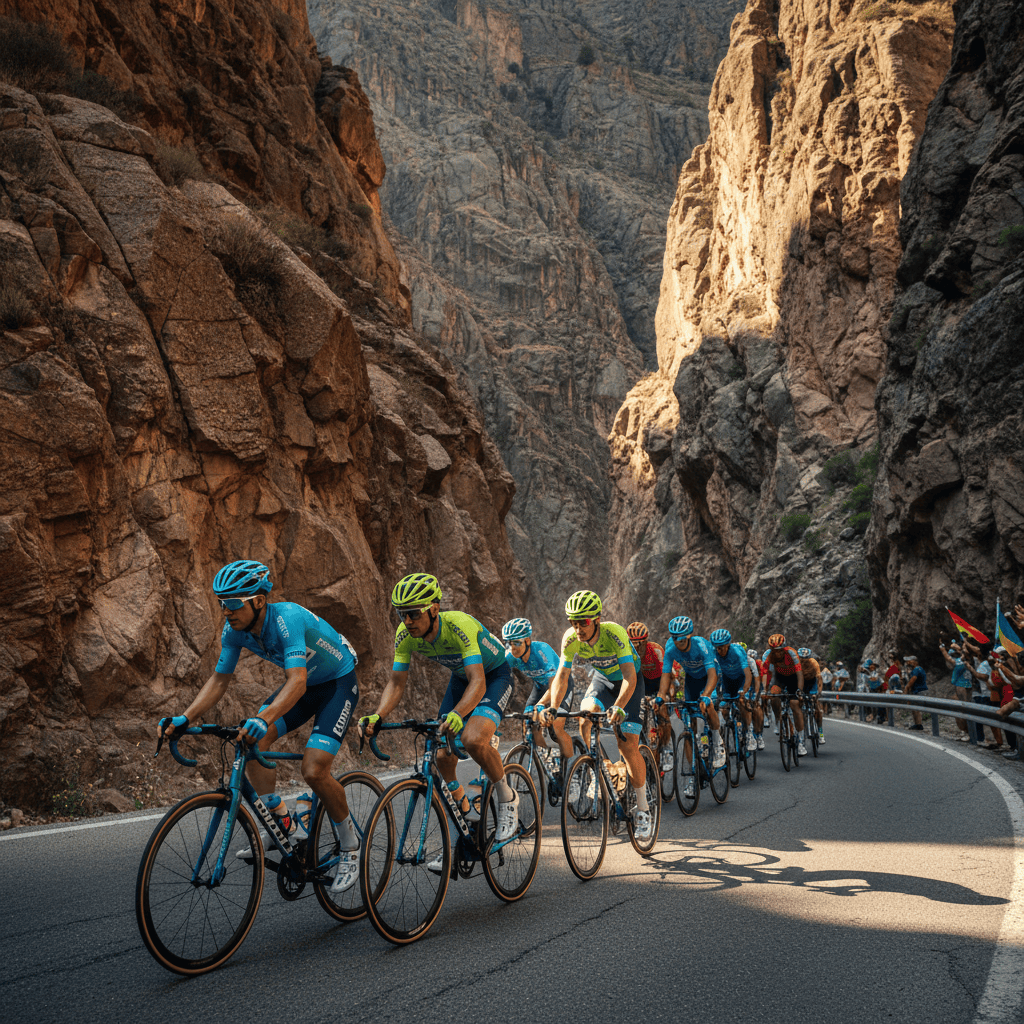
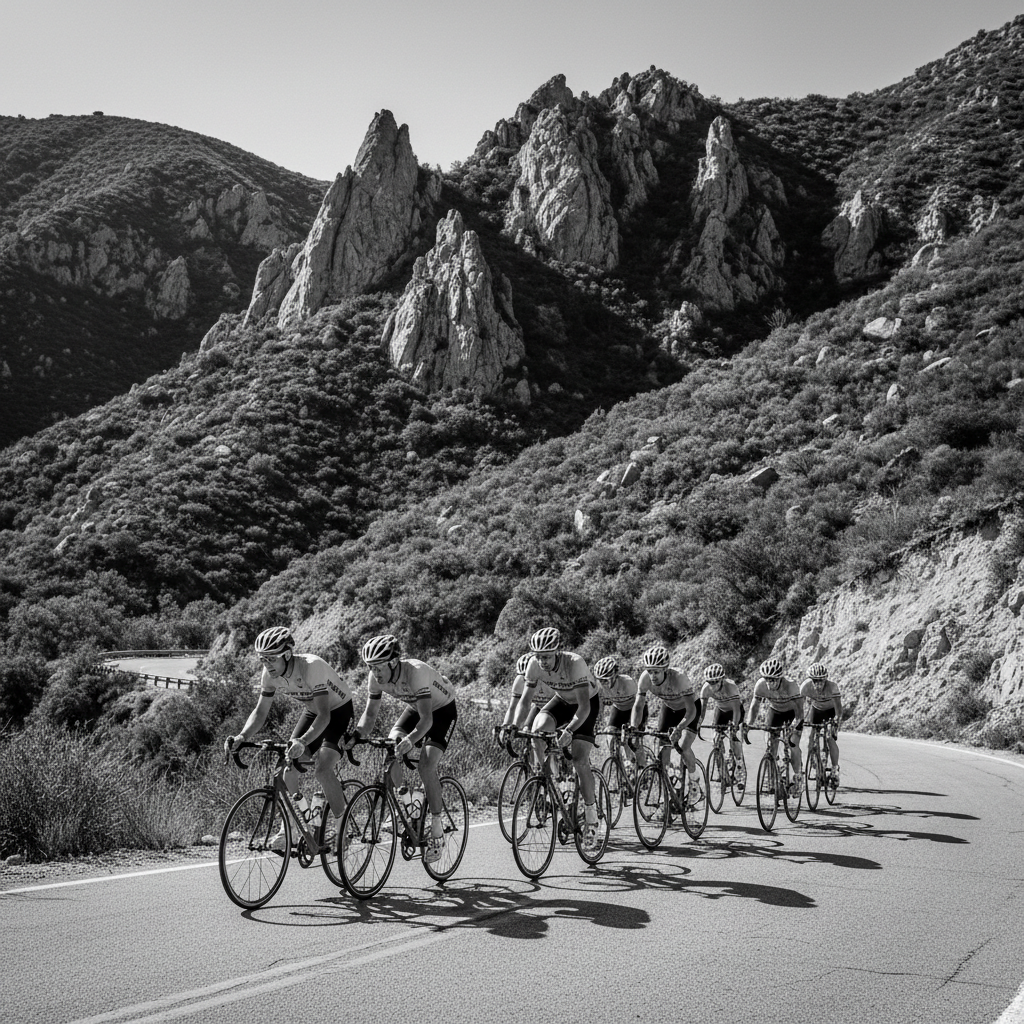
A peloton.
Eleven gentlemen — and I counted, for the record, having nothing else to do with my morning — of a combined age well north of six hundred, in full professional kit: the Lycra, the logos of banks and mineral waters that have never sponsored them, the little shoes that clack, the wraparound spectacles of a man expecting weather at fifty miles an hour who is travelling at ten. Ten miles an hour. Uphill. Two and three abreast across the climbing lane, pedalling with the unhurried majesty of men who have read the vehicle code and found in it, like scholars discovering a loophole in scripture, the single sentence that entitles them to everything.
And here I must be scrupulously fair, because fairness is the house brand: they were breaking no law. I know this. They know this. It is, I suspect, the entire point. The bicycle is legally a vehicle; the vehicle is entitled to the lane; the lane, therefore, belongs to the eleven gentlemen for as long as their haunches hold out, and the mile of families idling behind them — burning fuel, burning daylight, burning what remains of the American weekend — is simply the cost of somebody else’s cardio. The law has been read. The map of what is decent has been left, as usual, in the glove compartment of civilisation, unconsulted.
We crawled. They pedalled. On the rare straightaways, a few brave sedans made their break for freedom across the double yellow, performing manoeuvres that would alarm a stunt coordinator, because the peloton does not bunch up to let anyone by — the peloton converses. They ride abreast in order to chat, you see. It is more sociable. A gentleman on Twitter — a broadcaster, a keen cyclist — once posted a video of exactly this and declared it the correct way to ride, on the grounds that it is “more pleasant” for the riders. I have no doubt that it is. Many things are more pleasant for the doer. That has never previously been the test.
And when at last the canyon released us onto the Pacific Coast Highway, did the ordeal end? Reader, a large portion of the Pacific Coast Highway is currently a construction zone, still working through the disaster caused by the wildfires last year. It is a slalom of cones, closures, and flagmen through which four lanes of humanity are being threaded like a rope through a needle — and through this needle, weaving between the cones with the serenity of men to whom consequences are a rumour, went more of them. Different jerseys, same haunches. In the one stretch of coastline where every driver is already navigating a puzzle, the puzzle had been garnished.
Now, I want to establish that this is not a local affliction, because I have field notes from three countries. I have seen the phenomenon in the south of France and along the Spanish coast, where every summer the flatlands of the north, entire countries that God, in His wisdom, ironed — export their surplus males to the one thing their homelands cannot provide: a hill. They arrive in packs of twenty and thirty, in matching kit, trailed — and I need you to believe me here — by support vehicles. Actual vans, with actual spare wheels on the roof, crawling behind the formation with hazard lights pulsing, as though what is occurring on this public road between two fishing villages is not a hobby but a stage, as though the Tour de France had simply mislaid one of its legs and these gentlemen were sportingly returning it. The Mediterranean hill towns endure this the way they once endured other northern invasions: shutters closed, prayers muttered, waiting for autumn.
The internet, I discovered upon returning home and typing with more force than the keyboard strictly required, has a word for the species: MAMIL — Middle-Aged Man In Lycra — an acronym so precise that its coiner deserves whatever chair of taxonomy is currently vacant. The internet has also assembled the full charge sheet, and I can corroborate every count from personal observation. The riding two, three, and four abreast on roads with blind corners, where the oncoming driver’s first notice of the formation is the formation itself. The fifteen miles an hour in a forty-five zone, twenty vehicles in tow, with pull-outs passed and ignored like unsuitable suitors. And my personal favourite, which I have witnessed at the bottom of the very canyon in question: the red-light leapfrog — the rider who filters up the side of the queue at the signal, plants himself in front of the car that overtook him at great cost half a mile back, and obliges it, when the light turns, to run the entire gauntlet again. I once watched a Volvo overtake the same cyclist four times in three miles. Sisyphus, at least, was pushing his own boulder.
There was also the morning in the south of Spain — I set this down as evidence of pattern, not of grudge — when a squadron of ten or so Dutch descended upon the café where I was taking my coffee, colonised the terrace in a single coordinated action, and settled in, in full kit, cleats clacking across the tile like a tap troupe warming up. The staff of that establishment were, as the staff of southern Spain reliably are, kindness itself — and I watched them run for the better part of an hour, fetching, adjusting, accommodating, absorbing a stream of instructions issued in the clipped, condescending register of men addressing servants they intend not to tip, delivered with the general air of a delegation inspecting a colonial holding. The waiter and I exchanged the briefest of looks as they departed, and in it passed everything that needed to be said between civilisations.
So let us arrive at the question, because there is one, and I have been circling it since the second bend of the canyon: why? Nobody walks in L.A. — the song established this decades ago, and the song was a documentary. And nobody — this is the codicil the song assumed too obvious to sing — nobody bicycles in L.A. on the open road, between the hurtling metal and the canyon walls, for transportation. No one in that peloton was going anywhere. That is the part I ask you to sit with. Every other user of that road had a destination — a beach, a job, a family obligation, a parole meeting, something. The eleven gentlemen had a loop. They would end where they began, having produced nothing but lactic acid and a mile of exhaust, and the road — a public utility, built and maintained at staggering cost for the movement of people who need to move — had been requisitioned as exercise equipment. It is the gymnasium turned inside out: rather than the man going to the machine, the man has declared the entire canyon his machine, and the rest of us are merely the resistance setting.
And why here, of all the surfaces on earth? Because I must now say a word about the California public road, and the word is pothole. Our roads are not roads so much as archipelagos of asphalt in a sea of crater — maintained, by a state that taxes us like a Renaissance principality, to the standard of a minefield after the war has moved on. To take a machine with tyres the width of a garden hose onto this surface, at speed, downhill, in a pack, is not sport; it is an actuarial event, scheduled and merely awaiting its date. And let me be precise about where my sympathies lie, because they are not where you think. The gentlemen’s clavicles are their own business — a man of sixty who gambles his skeleton against a road built by the lowest bidder has made an adult wager, and I respect a gambler. My concern is for the other party to the inevitable transaction: some entirely innocent soul, driving to work or to the beach at the lawful speed, who will come around one of those blind corners and find the wager being settled across both lanes — and who, though guilty of nothing but proceeding through a public road at the posted limit, will spend the next decade in courtrooms and the rest of his life in the small hours of the night, replaying a corner he could not have taken differently. The peloton wagers its bones. It wagers our peace alongside them, without asking, and that is the part of the stake they never seem to count.
And then there is the matter of the alleged health benefit, which I have saved for last because it is my favourite. Consider the conditions. It has not rained in Los Angeles in six months — and since six months is, in the New World, the outer limit of recorded history, we may state it as the song does and call it settled science: It Never Rains in Southern California. The hills have gone the colour of a biscuit, and the dust has achieved a density at which it may soon qualify for representation. Above it, the sun, at scorching, unmediated, dermatologist-enriching strength. And through it — this is the detail I treasure — the exhaust of a full mile of idling vehicles, pumping their fumes into the canyon air at a rate the vehicles themselves would never have achieved had they been permitted to drive at the speed limit. Do you see it? The masterpiece? The peloton manufactures the traffic jam, and then, lungs heaving at maximum athletic capacity, hearts at a hundred and sixty, breathing at ten times the resting rate, the peloton inhales it — dust, particulates, tailpipe and all — marinating itself, at great cardiovascular effort, in a haze of its own creation. This is the health benefit. A man on a sofa with a cigarette is metabolising less poison. I have run the arithmetic several times and it always comes out the same: they have invented a form of exercise whose principal output is the very substance it forces them to breathe, and they have driven ninety minutes and spent eleven thousand dollars on carbon fibre to do it.
And for this there exist alternatives so obvious, so plentiful, so air-conditioned, that I can only conclude they have been examined and rejected on principle. I know an establishment — I have written of it; the towels have ambitions — that contains a full squadron of stationary bicycles, each one offering the identical cardiovascular experience plus a screen that will simulate, if asked, this very canyon, in higher resolution and without the mile of hostages. But the stationary bicycle, you see, has no audience. And there, I suspect, is the marrow of it. The kit, the formation, the support van, the conversational two-abreast — none of it is about the exercise. It is about being seen exercising, on the largest stage available, before the largest possible crowd — and a crowd, conveniently, is exactly what a blocked canyon produces. The audience is not incidental to the performance. The audience is the performance. We have discussed this dynamic before, at the Costco, with the toast-holders; the peloton is the same opera, in tighter costume, at ten miles an hour.
The remedies I offer in a spirit of generosity. Get the gym membership. Get the stationary bicycle; I will personally recommend a model. Or — and I say this with real respect for the scale of the ambition — do it properly: bribe the politician, close the road, hang the banners, and give us a race. The great cities do this. One Sunday a year, the road belongs to the bicycles entirely, honestly, officially, and everyone knows to sleep in. I would support this. I would donate. Because a closed road is an arrangement between consenting adults, and a blocked canyon is eleven men helping themselves to a Saturday that a thousand people had other plans for.
Until then, gentlemen: the light has changed, the flagman is waving, and somewhere behind you, in a line stretching back to the second bend, an entire county would like to go to the beach.
We were here first. We were also here second through four-hundredth.
 Dear Other People...
Leave a comment